


Description
UltraMarathonRTTM Reverse Transcriptase Kit is designed to meet the evolving needs of the RNA research community. It is an ultra-processive reverse transcriptase that uses a single pass to create cDNAs from any type of RNA, including long, highly structured templates. Importantly, uMRT works optimally at ambient temperatures (20-42ºC) removing any need to heat the RT reaction which preserves the integrity of your RNA samples.
Used for gene expression, RT-PCR, qRT-PCR, and other first strand cDNA synthesis applications with RNA input as low as 0.1 pg.
UltraMarathonRT Reverse Transcriptase Kit components:
- UltraMarathonRT
- 2x RT Buffer
- High Boost
- Nuclease-free water
Catalog# R1002S (20 reactions), R1002M (50 reactions), R1002L (100 reactions)
Reagents required but not supplied:
- dNTP mix stock (10 mM each)
- The dNTP mix contains premixed aqueous solutions of dATP, dCTP, dGTP and dTTP, each at a final concentration of 10 mM. High purity nucleotides (>99%) are recommended, and the pH should be adjusted to 7.0 with sodium hydroxide.
- Oligo-dT primer, random primer or gene specific primer
- RNA template: 1 pg-2 μg total cellular RNA or 1 pg-500 ng of mRNA are recommended for each reaction.
Storage conditions: For short duration of storage (< 3 month), UltraMarathonRT can be placed in a -20℃ freezer. -80℃ is recommended for long-term storage. Note that UltraMarathonRT can endure 10 freeze-thaw cycles without losing noticeable activity. After 20 freeze-thaw cycles, UltraMarathonRT maintains 90% of its original activity.
Contact us at orders@dmarkbio.com for the list of publications.
How much of the transcriptome are you missing?
The process of reverse transcription (RT) enables researchers to “see” the transcriptome. However, most RT enzymes lack robust processivity - the ability to efficiently and continuously synthesize cDNA without dissociating from the RNA strand - making the transcription of long, highly structured, or modified RNA transcripts difficult. Furthermore, most RT enzymes operate at temperatures that can damage RNA, jeopardizing the detection of complex and low-abundance transcripts. As a result, researchers may be missing RNA transcripts in their samples.
Generate unbiased data with an RT enzyme that goes the extra mile
UltraMarathonRT (uMRT) is a next-generation reverse transcriptase built to reveal transcriptomic diversity in biological samples. Structurally distinct from other RT enzymes, uMRT operates at ambient temperature, preserving RNA integrity. uMRT uses its unmatched helicase activity to unwind complex RNA structures and its enhanced processivity to fully transcribe long, structurally complex transcripts in a single pass and at single-cell levels, enabling you to capture transcript data that is more representative of the diversity in your sample.

Transcribe any RNA in a single pass
Transcribe entire >30kb viral genomes with enhanced enzyme processivity.

Operate at ambient temperatures
Preserve RNA integrity with lower reaction temperatures 30°C

Power through complex transcripts
Unmatched helicase activity unwinds complex RNA structure to enable complete 5’ end to 3’ end sequencing of previously invisible regions:
• Highly structured RNAs
• Centromeric regions

Detect RNA modifications
Uncover RNA modifications:
• Epitranscriptome
• RNA secondary structures
• RNA editing sites
• Post-transcriptional

Simplify library prep with efficient template switching
Create full-length cDNAs in a simplified reaction even when the 5' end of the RNA sequence is unknown.
Identify more genes
Changing the standard RT to uMRT enabled the identification of 25% more genes.
Comparison of uMRT and SSII in a representative SMART-seq experiment.
uMRT identified more genes in each RNA class.
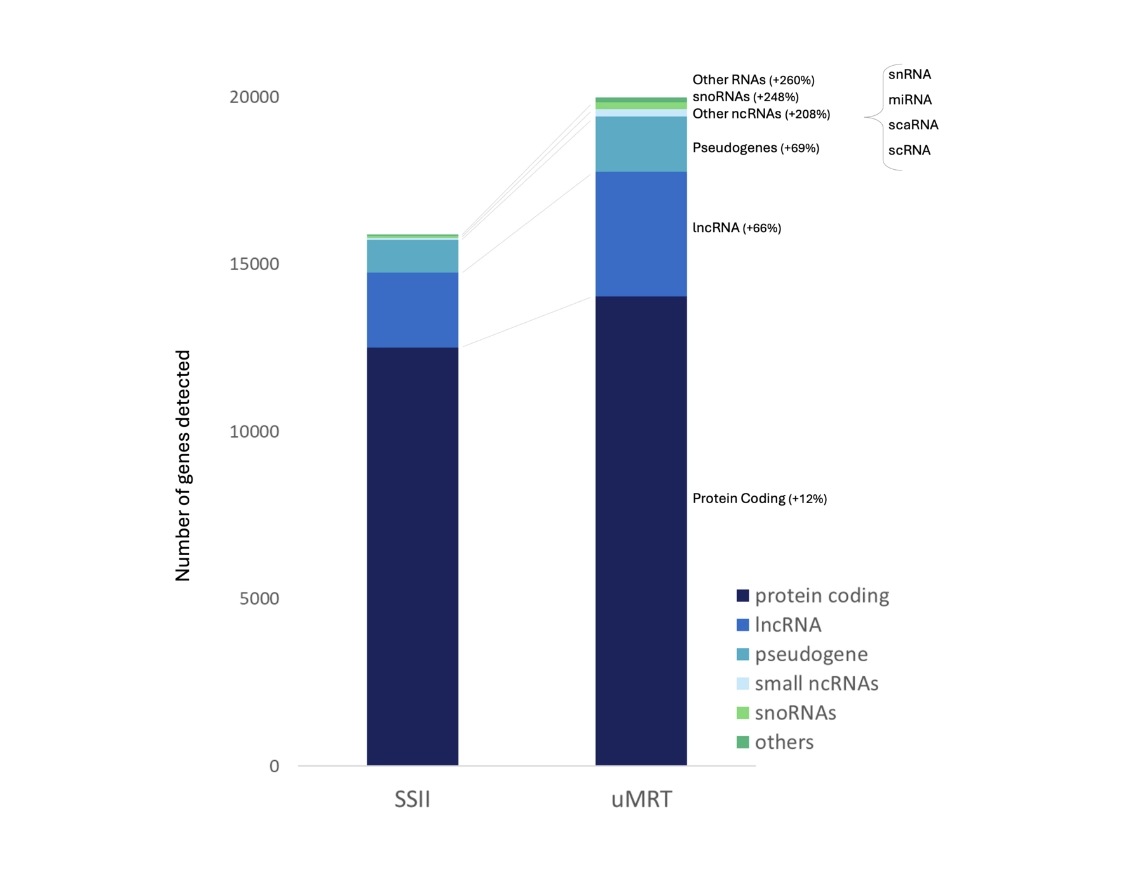
Guo L-T., Grinko A., Olson S., et al. (2024). Characterization and implementation of the MarathonRT template-switching reaction to expand the capabilities of RNA-Seq. RNA. doi:10.1261/rna.080032.124.
Discover challenging transcripts
uMRT enables more accurate, unbiased transcriptome analysis
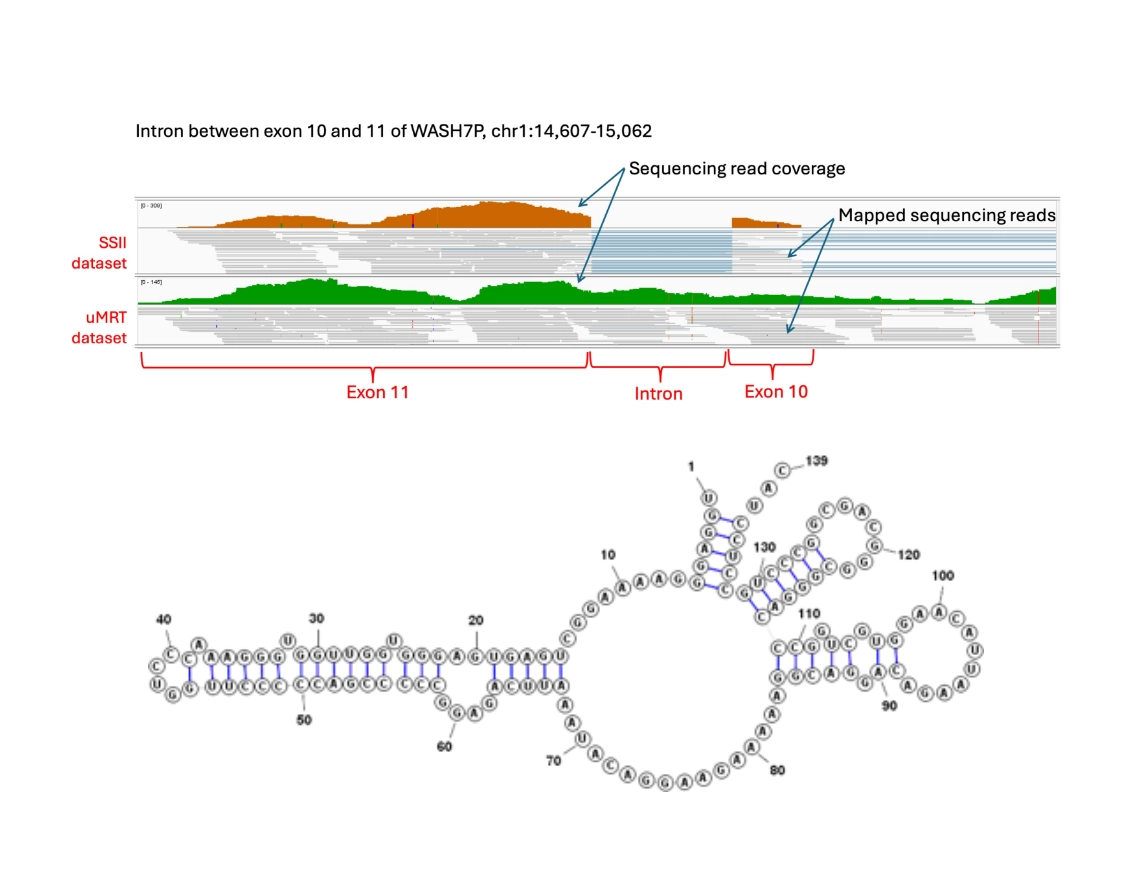
In a representative experiment, there were no sequencing reads from the SSII dataset mapped to the intron sequence between exon 10 and 11 of the WASH7P gene [top] which contains a stable structure [bottom].
In contrast, the intron can be efficiently detected by uMRT with its natural helicase activity.
Protect RNA integrity
uMRT works optimally at ambient temperatures, preserving the integrity of RNA samples
RNA samples (particularly long, structured RNAs or very low abundant RNAs) are delicate and degrade rapidly when heated. uMRT works optimally at 20-42ºC.
In the figure [right], an HCV RNA was incubated in a diversity of buffer conditions without enzyme to evaluate the impact of temperature on template stability. Samples were analyzed using the Agilent 2100 Bioanalyzer system. Incubation in uMRT buffer at 30ºC shows no degradation of HCV RNA through 30 minutes.

Downloads: